

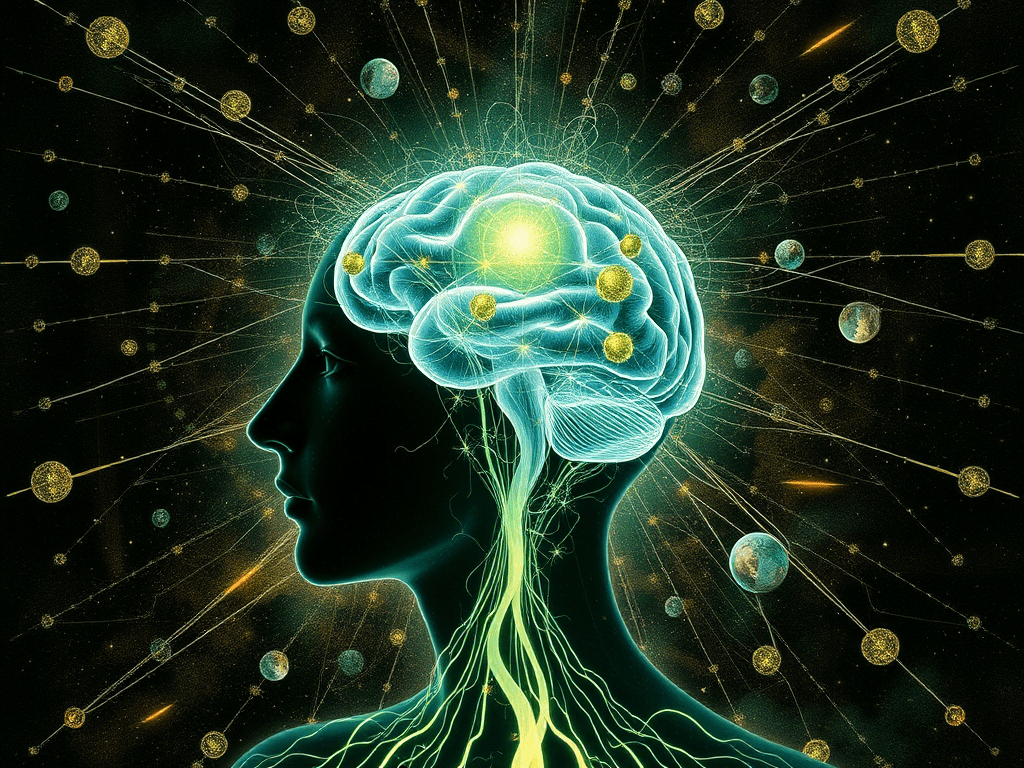
Consciousness: The Mystery of the Mind
Consciousness is the lens through which we experience the world. It defines our sense of self, our thoughts, emotions, and interactions with our environment. Yet, despite its central role in human existence, we are still far from understanding how consciousness arises. This makes it one of the most profound and elusive subjects in science, philosophy, and psychology. In this blog, we will explore the intricate and multifaceted concept of consciousness. From its basic definition to the most advanced theories and its relationship with the brain, we will dive into the depths of this enigmatic phenomenon.

What Is Consciousness?
Consciousness can be described as the awareness of our own mental processes, feelings, perceptions, and surroundings. It is the ongoing experience of being aware of both the self and the world. Consciousness is not just a passive observation; it is an active engagement with the environment, shaped by our thoughts, memories, desires, and awareness of time and space.
At a basic level, consciousness can be categorized into three types of awareness:
- Self-awareness: This refers to the ability to recognize and reflect upon oneself as a distinct entity. Self-awareness means understanding one’s identity and existence. It’s a step beyond simply being alive—it’s the recognition of your own thought processes, emotions, and your place in the world.
- Environmental awareness: This is the perception of the external world—our sensory experiences of what’s happening around us. This includes the awareness of physical objects, sounds, smells, and social interactions.
- Awareness of thoughts and emotions: Our conscious experience also involves understanding our thoughts and feelings. This includes the ability to reflect on our mental state, question our beliefs, and recognize our emotional reactions to situations.
Thus, consciousness is the complex combination of all these awarenesses, and understanding it requires examining both its components and the processes that generate them.
Theories of Consciousness: Exploring the Mind’s Mysteries
The question of how and why consciousness arises from the brain has eluded philosophers, neuroscientists, and psychologists for centuries. There are several theories that attempt to explain how consciousness arises from neural processes, and each offers a unique perspective on this complex issue.
1. Integrated Information Theory (IIT)
The Integrated Information Theory (IIT), proposed by neuroscientist Giulio Tononi, suggests that consciousness arises when a system integrates complex information in a unified way. This theory posits that consciousness is not simply the sum of individual parts or neurons working independently but is rather the result of how information is processed and integrated across the brain’s networks.
IIT focuses on the idea that consciousness depends on a system’s ability to integrate information in a way that is not reducible to the properties of the individual components of the system. It emphasizes that conscious experience occurs when the brain processes information in a highly interconnected manner. According to IIT, the more complex and integrated a system’s information, the higher its level of consciousness.
One of the groundbreaking aspects of IIT is its mathematical framework, which allows for the quantification of consciousness. By measuring the integration of information across neural networks, this theory could help explain why consciousness occurs and could even be used to compare levels of consciousness in different beings or systems.
2. Global Workspace Theory (GWT)
The Global Workspace Theory (GWT), proposed by psychologist Bernard Baars, views consciousness as a “global workspace” in the brain where different cognitive processes converge and interact. This theory suggests that our conscious experience arises when information from different regions of the brain is integrated and made available to the “global workspace.”
In this model, the brain can process various tasks simultaneously, but only information that enters the global workspace becomes part of our conscious awareness. GWT compares consciousness to the role of a stage in a theater: the conscious mind is like the stage where the most important and relevant pieces of information are displayed, while the backstage processes (unconscious activities) continue without being part of the conscious experience.
GWT emphasizes that consciousness serves as the mechanism that makes certain information accessible for decision-making, planning, and problem-solving. It highlights the role of attention in focusing the conscious mind on specific information while relegating other information to unconscious processing.
3. Higher-Order Theories (HOT)
Higher-Order Theories of consciousness suggest that consciousness is dependent on our ability to think about our own thoughts—this is referred to as meta-cognition. According to this theory, a thought becomes conscious not just because it is processed by the brain, but because we are aware of the thought. This means that consciousness arises when we can reflect upon and represent our own mental states.
For example, when you think about a memory or plan your day, you are not only aware of the content of that memory or plan, but you are also aware that you are thinking about it. This metacognitive awareness allows us to reflect on our experiences, question our beliefs, and engage in complex thought processes. The Higher-Order Thought Theory argues that consciousness is essentially a form of self-reflection.
4. Quantum Consciousness Theory
One of the most controversial and speculative theories of consciousness is Quantum Consciousness, proposed by physicist Roger Penrose and anesthesiologist Stuart Hameroff. This theory posits that consciousness might be linked to quantum mechanics—specifically, the behavior of subatomic particles like electrons, photons, and atoms.
Penrose and Hameroff suggested that microtubules—tiny structures within neurons—might function as quantum computers. They propose that the quantum behavior of these particles could give rise to conscious experience. The theory suggests that consciousness may arise from quantum-level processes that are not yet fully understood. While the theory is fascinating, it remains controversial, and there is no definitive evidence to support it.
The idea of quantum consciousness challenges our current understanding of the brain and consciousness and suggests that there might be aspects of the mind that cannot be explained by classical physics alone.
Consciousness and the Brain: Understanding the Neural Basis
Understanding consciousness requires an exploration of the brain—the organ most directly responsible for producing conscious experiences. Modern neuroscience has made substantial progress in mapping the brain and identifying the regions involved in conscious thought and awareness.
Brain Regions Involved in Consciousness
Consciousness is not localized to a single area in the brain. Rather, it arises from the interaction of multiple regions, each contributing to various aspects of conscious experience. Some key brain regions involved in consciousness include:
- Prefrontal Cortex: This region, located in the front of the brain, is crucial for higher cognitive functions like decision-making, problem-solving, and planning. The prefrontal cortex is particularly involved in self-awareness—our ability to think about our own thoughts, plan future actions, and engage in goal-directed behavior.
- Thalamus: The thalamus is often referred to as the “gateway” to consciousness. It acts as a relay station for sensory signals coming from the body to the appropriate areas of the brain. It helps integrate sensory information and sends it to the cortex for processing. Damage to the thalamus can lead to disruptions in consciousness, including coma or vegetative states.
- Reticular Activating System (RAS): The RAS is responsible for regulating wakefulness and alertness. It determines whether we are in a conscious state or unconscious. The RAS is also involved in regulating sleep and maintaining a general level of arousal, which is necessary for conscious awareness.
- Amygdala: The amygdala plays a critical role in processing emotions and emotional memory. While it is not directly responsible for creating consciousness, it is deeply involved in emotional awareness and the emotional aspect of conscious experience.
- Occipital and Temporal Lobes: These areas are responsible for processing sensory information, such as sight and sound. The visual cortex in the occipital lobe is essential for conscious visual perception, while the auditory cortex in the temporal lobe contributes to our awareness of sounds.
These regions work in concert to produce the rich, multifaceted experience we know as consciousness. Understanding how they interact, and how disruptions in these areas can lead to altered states of consciousness, is crucial for understanding the neural basis of awareness.
The Mysteries of Consciousness: The Hard Problem
Despite advances in neuroscience, the Hard Problem of Consciousness—a term coined by philosopher David Chalmers—remains one of the most profound challenges in the study of consciousness. The Hard Problem focuses on the question: Why and how do physical processes in the brain give rise to subjective experience?
While we can measure brain activity and identify areas of the brain responsible for specific cognitive tasks, we still don’t understand how or why this leads to the conscious experience of seeing the color red or feeling sadness. How does the firing of neurons translate into the sensation of pain, or the perception of a beautiful sunset?
This question goes beyond explaining how the brain works. It asks why the brain’s activity produces conscious experience in the first place. Why do we have qualia—the internal, subjective aspects of experience—at all? These are the fundamental questions that remain unanswered, and they challenge our very understanding of consciousness.
Consciousness in the Context of Artificial Intelligence
With the rise of artificial intelligence (AI), one of the most intriguing questions has emerged: Can machines be conscious? AI has made remarkable strides in fields like natural language processing, computer vision, and autonomous decision-making. But can a machine ever achieve subjective experience? Can an AI truly be aware of itself and its environment in the same way humans are?
The idea of a conscious machine raises both ethical and philosophical concerns. If a machine could become conscious, would it have rights? Would it be capable of emotions? Could it develop a sense of self-awareness? These questions are not purely speculative—AI is rapidly advancing, and we are starting to create systems that can simulate human-like thought processes. The future of AI and consciousness is an area of intense debate among scientists, ethicists, and philosophers.

Can Consciousness Be Transferred to Machines?
Another futuristic idea is the concept of mind uploading—the possibility of transferring human consciousness into a computer. If we could map the brain’s complex neural connections, could we recreate consciousness in a digital form? This raises a host of questions, from the feasibility of such technology to the ethical implications of “digital immortality.”
Even if mind uploading becomes technically possible, it remains unclear whether the consciousness transferred to a machine would truly be the same as the original consciousness. Would it retain the individual’s memories and personality, or would it simply be a copy of the person’s mind?
Conclusion: The Endless Exploration of Consciousness
Consciousness remains one of the most profound and puzzling phenomena in science and philosophy. Despite remarkable advancements in our understanding of the brain, we are still a long way from understanding how subjective experience arises. Theories like Integrated Information Theory, Global Workspace Theory, and Quantum Consciousness offer fascinating insights, but the Hard Problem continues to challenge researchers and philosophers alike.
The connection between the brain and consciousness, the potential for AI to develop self-awareness, and the possibility of mind uploading are all exciting frontiers in consciousness research. As technology advances, we may eventually unravel the mystery of consciousness, but for now, it remains one of the most captivating and elusive aspects of the human experience.
Learn More About Brain-Computer Interfaces (BCIs)
To dive deeper into the fascinating world of Brain-Computer Interfaces (BCIs) and their potential to revolutionize how we understand and interact with the brain, check out this detailed article:
Brain-Computer Interfaces (BCIs): Connecting the Mind to Machines.
Interested in More Mysteries?
- If you find yourself intrigued by the mysteries of consciousness and other fascinating topics, be sure to explore more thought-provoking articles in this collection: The Mysteries.
- From exploring the depths of human perception to unraveling the latest advancements in science and technology, this collection offers a deeper look at the questions that challenge our understanding of the world. Join us on a journey through the unknown and discover new perspectives on some of the most profound topics of our time.
- Image Credits : The image was created by SR TechVerse.